
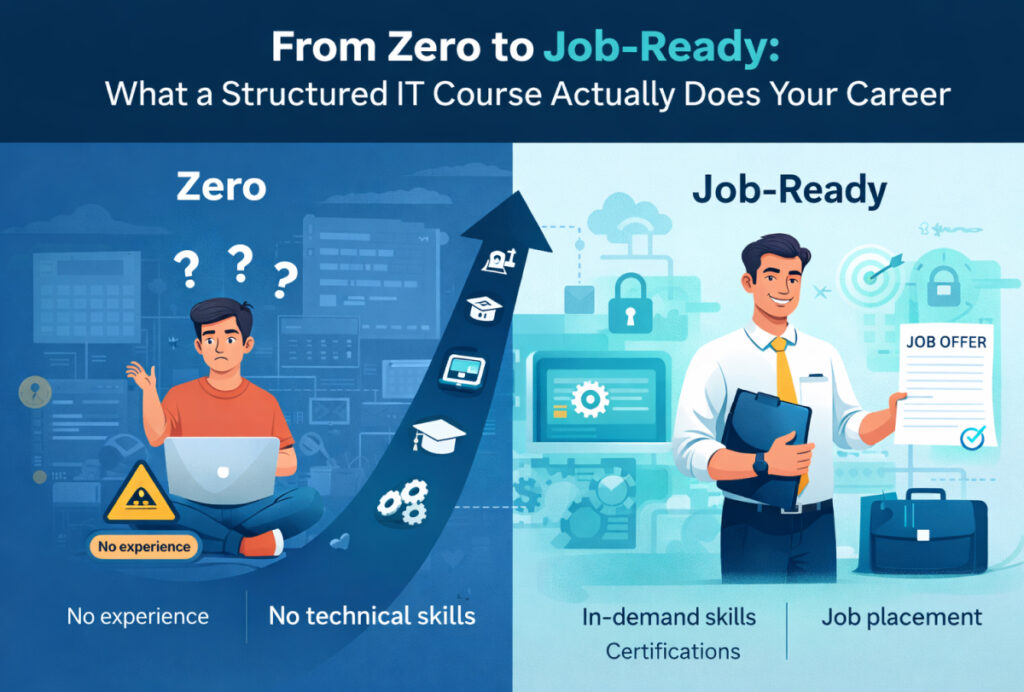
Find out how a structured IT training course transforms students with no coding background into job-ready tech professionals — and what to look for when choosing the right program
The Difference Between Watching Tutorials and Actual Training
We are living in an era of infinite free content. You can find tutorials on every programming language, framework, and tool ever created — across YouTube, blogs, documentation pages, and online forums. And yet, the number of students who consume hours of this content and still cannot pass a basic technical interview or build a working project from scratch remains surprisingly high.
The reason is not lack of effort. It is the fundamental difference between passive consumption and active, guided skill-building. Watching someone solve a problem teaches you what a solution looks like. Structured training teaches you how to think through a problem yourself — which is the only version of learning that actually transfers to a job.
Why Most Self-Taught Learners Hit a Ceiling
Self-directed learning works well in the early stages — building basic familiarity, understanding syntax, following along with small exercises. But most self-taught learners encounter a ceiling somewhere between beginner and intermediate level. The tutorials run out of direct guidance. The problems get more open-ended. The path forward becomes unclear.
This is the point where structured training makes the greatest difference. A well-designed IT course does not just deliver content — it sequences learning in a way that builds each new concept on a solid foundation, provides feedback when you go wrong, and pushes you progressively into deeper problem-solving territory. That scaffolding is what converts interest into genuine capability.
New Batch: Structured IT and Web Development Courses Now Open
Our next training batch is open across multiple IT disciplines including full-stack web development, mobile application development, digital marketing, and e-commerce platform specialisations. Programs are available in both online and offline formats and are built for students who want job-ready skills — not just course completion certificates.
What a Good IT Training Program Actually Covers
Not all IT courses are built equally. The ones that produce consistently employable graduates share a set of common characteristics that go far beyond the syllabus. Here is what separates training that transforms careers from training that simply fills time:
- Current Technology Stacks: The curriculum should reflect what companies are actually hiring for today — not what was popular three years ago. Languages, frameworks, and tools evolve quickly, and your training should keep pace with that.
- Project-Based Learning: Every major concept should be applied to a real project — not a toy exercise, but something that produces a working, demonstrable output you can add to your portfolio and talk about in interviews.
- Industry-Relevant Assessment: Being tested on your knowledge is less valuable than being tested on your ability to apply it. Good programs include code reviews, project evaluations, and mock technical challenges that mirror what you will face in actual hiring processes.
- Soft Skills Integration: Technical knowledge gets you to the interview. Communication, professionalism, and the ability to explain your thinking clearly is what gets you the offer. Programs that address both sides of this equation produce significantly better placement outcomes.
The Role of Real Projects in Making You Hireable
There is a single question that runs through almost every junior tech hiring decision: can this person actually build something? Not theoretically — actually. Hiring managers know that freshers will not arrive with years of experience. What they are looking for instead is evidence of applied capability.
A portfolio of two or three projects — a functional website, a mobile application, an e-commerce build, or a digital marketing campaign with measurable results — provides that evidence directly. Students who graduate from structured programs with project work already completed have a concrete, specific answer to the most important question in tech hiring. That distinction closes job searches months faster than qualifications alone.
Placement Support That Goes Beyond Handing You a Certificate
A certificate tells an employer you completed a course. Placement support puts you in front of employers who are already looking to hire. Our program combines technical training with active job placement assistance — including resume building tailored to tech roles, mock technical interviews, LinkedIn profile optimisation, and direct referrals to hiring companies within our network.
We measure our success by where our students end up — not just by how many of them finish the course.
Your Tech Career Does Not Have to Start With a Full-Time Job
One of the most liberating realisations for tech students is that employment is not the only valid entry point into a career. Internships, freelance projects, and open-source contributions all build real experience, real income, and real professional networks. Many of our graduates take their first steps through our internship support program — building their skills in live environments before transitioning to permanent roles. Others move directly into freelancing, picking up client work while still in training. The path is rarely linear, and that is entirely fine. What matters is that you start moving.